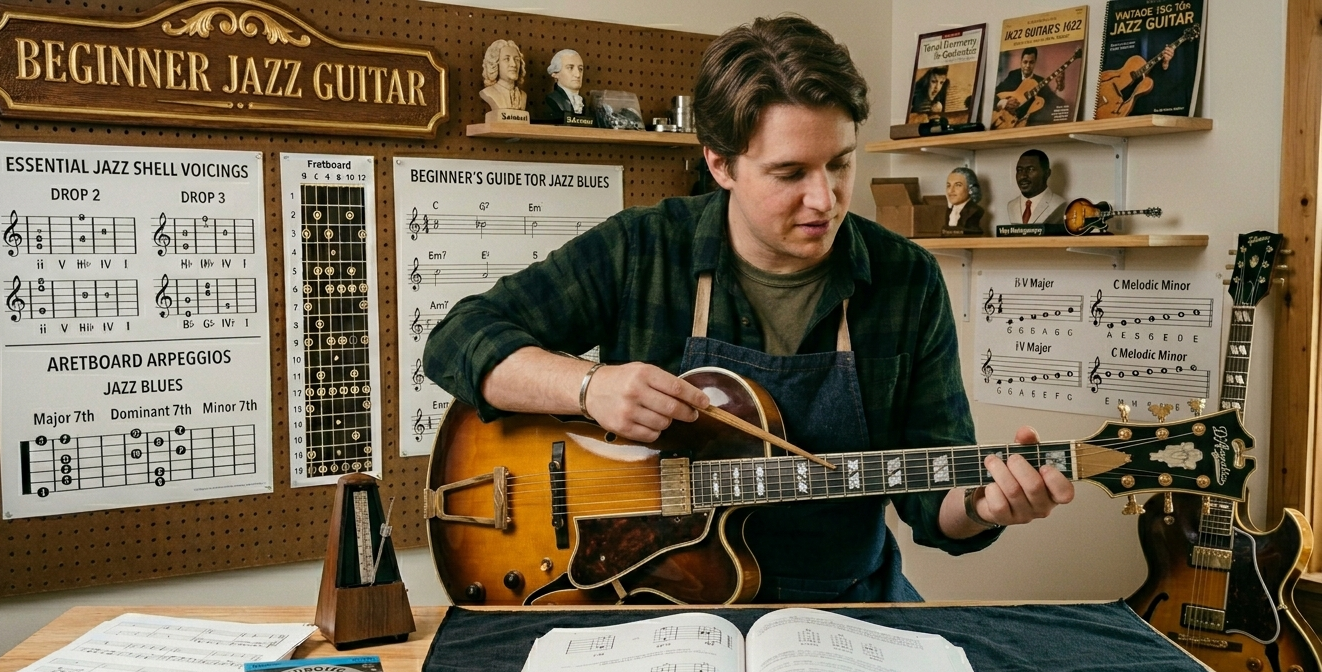
Jazz guitar has a reputation for being impossibly complex the theory is dense, the chord voicings look like the fretboard is on fire, and the improvisation sounds either effortless or completely random depending on the player. All of that reputation is earned. Jazz is genuinely demanding. But the entry path is wider than it looks, and getting meaningfully into jazz as an intermediate guitarist doesn’t require years of music conservatory preparation.
What it requires is honest reorientation of your expectations and a willingness to spend real time with unfamiliar harmonic territory. This is a guide for players who already know their open chords, have some understanding of the fretboard, and want to take a real first step into jazz.
Why Jazz Chords Look Different
Most of the guitar chords you learned first open G, C, D, Em are triads or simple dominant sevenths using open strings. Jazz chords are almost exclusively closed-position voicings higher up the neck, and they’re typically more complex harmonically: major sevenths, minor sevenths, dominant ninths, flat-five chords. The extended harmony isn’t decoration it’s the central language.
The starting point for jazz chord vocabulary is the Drop 2 voicing system. Without going deep into the theory, Drop 2 chords are four-note voicings arranged for guitar that cover the essential jazz chord types in a way that’s physically playable and sonically full. Learning the Drop 2 major 7, minor 7, and dominant 7 voicings across the four string groups (6-3, 5-2, 4-1) gives you a working jazz chord vocabulary on a single neck position.
The II-V-I Progression: Jazz’s Core Grammar
The II-V-I (two-five-one) progression is to jazz what the I-IV-V is to blues it’s everywhere. In the key of C major: Dm7 (the II chord), G7 (the V chord), Cmaj7 (the I chord). This progression creates harmonic tension (on the V chord) that resolves to home (the I chord) in a way that feels simultaneously inevitable and satisfying.
Learn to play a II-V-I in several keys using your Drop 2 voicings. Then learn to recognize it in recordings. Listen to Miles Davis’s ‘Autumn Leaves,’ Thelonious Monk’s ‘Round Midnight,’ or any standard from the Real Book II-V-I is everywhere once you can hear it.
Jazz Scales: Where to Start
The Dorian mode is your entry point into jazz scale vocabulary. It’s a minor scale with a raised sixth, and it fits naturally over minor seventh chords which appear constantly in jazz. Minor II-V-I progressions, extended minor chord vamps, many jazz blues variations Dorian covers a huge amount of territory.
The Mixolydian mode covers the dominant seventh chord (G7 in a C major II-V-I). It’s a major scale with a flattened seventh, which gives it that slightly edgy, unresolved quality that makes dominant chords sound tense.
The bebop scale a dominant scale with an added chromatic passing tone between the flat seven and the octave is the defining sound of bebop jazz and the foundation of a huge amount of jazz guitar vocabulary. It sounds more complex than it is: it’s a way of playing a scale so that chord tones land on strong beats, which creates harmonic clarity even at fast tempos.
Learning Jazz: Why Standards Matter
Jazz standards are the common repertoire the songs every jazz musician is expected to know. Autumn Leaves, All The Things You Are, There Will Never Be Another You, Softly As In A Morning Sunrise these are the texts of the tradition. Learning even five or six standards properly gives you a working vocabulary of harmonic situations that recur constantly across the genre.
The Real Book is the standard reference originally a handwritten underground publication, now officially published by Hal Leonard. It’s worth having even if you don’t read music fluently; the chord symbols alone are enormously useful.
Common Mistakes When Starting Jazz Guitar
Trying to learn jazz improvisation before the chord vocabulary is solid: You can’t improvise well over changes you don’t hear clearly. Build your chord recognition first.
Ignoring the rhythm: Jazz rhythm is as important as the notes. Swing feel, comping rhythm behind soloists, and the interaction with the rhythm section are central to the music. Play along with recordings constantly not to match the guitarist, but to feel the time.
Practicing only alone: Jazz is a conversational music. Find other musicians to play with as soon as possible, even if it’s just two guitars. A lot of the language only reveals itself in interaction.
Conclusion
Jazz is a long game. You won’t sound like Wes Montgomery in six months, and accepting that is part of committing to it. What you will find is that the theory and listening skills you develop through jazz make you a better player in every other context the harmonic awareness, the time feel, and the vocabulary transfer across genres in ways that are hard to predict until you’re in it.
FAQ
Do I need to read music to play jazz guitar?
Reading standard notation helps significantly, especially for learning from lead sheets and the Real Book. But chord symbols and tab get you far. Many self-taught jazz guitarists learn by ear and chord symbol first, then add notation reading later.
What’s a good first jazz guitar to buy?
A semi-hollow body guitar like the Epiphone ES-335 or Gibson ES-335 produces the warm, rounded tone associated with jazz guitar. However, plenty of jazz guitarists play solid-body guitars. Tone preference matters more than category.
Are there good online resources for learning jazz guitar?
Jazz Guitar Online (jazzguitar.be) and Jens Larsen’s YouTube channel are both excellent, rigorous, and free. They’re genuinely good resources rather than surface-level content farms.