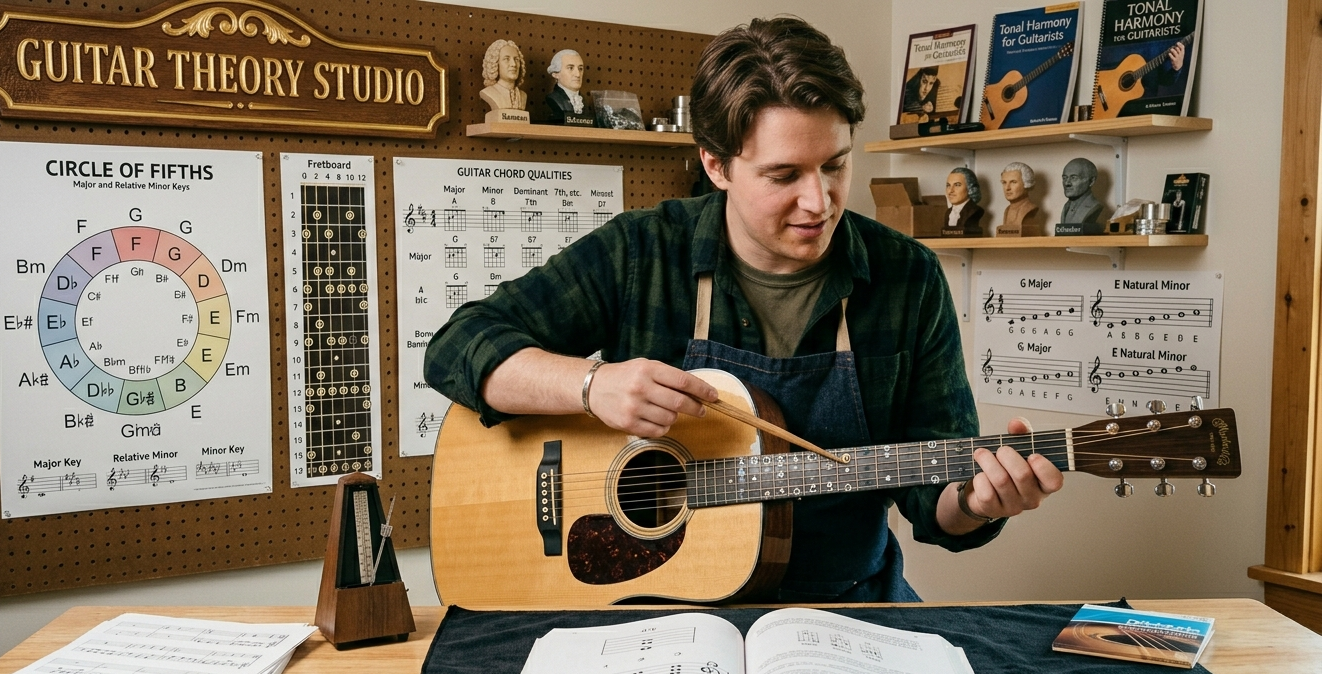
‘I don’t need theory I play by ear.’ You’ve heard this, maybe said it. And there’s something genuine in it music theory isn’t required to play emotionally resonant guitar. But the guitarists who say this often hit a ceiling they can’t explain: they can play within their comfort zone fluently, but when they’re asked to improvise over an unfamiliar chord progression, or write a song that doesn’t sound like their last three songs, or communicate with other musicians quickly, they get stuck.
Theory is a language. You can get by in a foreign country without learning the local language, but knowing it opens up a different level of engagement. These are the theory concepts that matter most specifically for guitar playing not a comprehensive music conservatory curriculum, just the things that will actually change how you play.
The Major Scale: The Foundation Everything Else Builds On
The major scale is the reference point for almost all Western music theory. Seven notes, a specific pattern of whole and half steps, and you have the architecture from which chords, keys, and modes are built.
On guitar, the most useful way to understand the major scale isn’t through notation it’s through patterns on the fretboard. The CAGED system gives you five different positions to play a major scale across the neck. Learn them. Not to use all five in every solo, but to understand that the same scale lives in multiple places on the fretboard, and you can move between those places.
The formula whole, whole, half, whole, whole, whole, half is worth knowing. Once you internalize it, you can build a major scale from any root note on any string, which unlocks the fretboard in a way that pattern memorization alone doesn’t.
Intervals: The Building Blocks of Melody and Harmony
An interval is the distance between two notes. Major second, minor third, perfect fifth these names describe specific distances that have specific sounds. Understanding intervals matters for guitarists because it teaches you why certain note combinations sound stable and others sound tense.
A minor third sounds sad or dark. A major third sounds bright. A perfect fifth sounds powerful and open it’s why power chords work so well for rock music. When you’re improvising and you want tension before resolution, reach for a note a minor second (one fret) above your target note, hold it, then resolve. You don’t need to know this intellectually to do it by feel, but knowing it means you can do it intentionally in any key.
The Nashville Number System
Used extensively in country, pop, and session music, the Nashville Number System is a shorthand for communicating chord progressions regardless of key. It assigns Roman numerals to each chord based on its position in the scale. The I chord is built on the first scale degree, the IV on the fourth, the V on the fifth, and so on.
Why does this matter for intermediate guitarists? Because it helps you recognize patterns across different keys. Once you’ve played the I-IV-V progression in G (G, C, D), hearing it transposed to A (A, D, E) or E (E, A, B7) sounds familiar immediately. You’re not learning new music you’re recognizing the same pattern in a different location.
The most common progressions in popular music are built on I, IV, V, and vi chords. In the key of G: G, C, D, Em. These four chords cover an enormous range of songs across every genre. Once you understand the numeral system, you can transpose this instantly to any key without thinking through each chord individually.
Modes: Useful Reality vs. Overhyped Complexity
Modes are one of the most over-complicated concepts in guitar theory education. Here’s the honest version: modes are scales derived from the major scale by starting on a different degree. The Dorian mode (starting on the second degree) is minor in feel but with a raised sixth it has a cool, slightly sophisticated quality used extensively in jazz and blues rock. The Mixolydian mode (starting on the fifth degree) is major but with a flattened seventh it sounds like classic rock and blues.
You don’t need to memorize all seven modes to use them. You need to know that the Dorian mode over a minor chord gives you a specific sound, and that the Mixolydian mode over a major chord gives you a blues-rock sound. Carlos Santana built much of his style on Dorian. Hendrix used Mixolydian extensively. Learn those two first and you’ve covered most of what modes offer practically.
Chord Construction: Why Chords Sound the Way They Do
Every chord is built from intervals stacked on a root note. A major chord is a root, major third, and perfect fifth. A minor chord is a root, minor third, and perfect fifth the only difference is the middle note, which changes the emotional character entirely. A dominant seventh chord adds a minor seventh on top of the major chord, creating the tension that resolves so satisfyingly to the tonic.
When you understand this, weird chords stop being mysterious shapes and start being logical constructions. A sus2 chord replaces the third with the second no major or minor character, which gives it that open, ambiguous sound. An add9 chord adds the ninth (same as the second but an octave up) to a major chord for color without losing the major feel.
Conclusion
You don’t need to know all of this to play well. But each piece of theory you internalize gives you a new tool one you can use deliberately rather than accidentally. The goal isn’t to analyze music while you play it. It’s to practice theory slowly until it becomes intuitive, at which point it disappears from consciousness and becomes part of your musical instinct.
FAQ
Do I need to read music to understand guitar theory?
No. Most guitar theory is taught through fretboard diagrams, tab, and the CAGED system without reference to standard notation. Reading music is a separate skill with its own value but is not required for the theory concepts that matter most to guitarists.
What’s the quickest theory concept to apply directly to my playing?
The pentatonic scale and understanding which key you’re in. This alone will let you improvise over a backing track in a way that sounds intentional rather than random, and it’s achievable in a few weeks of focused practice.
How do I learn to apply theory while improvising rather than just knowing it academically?
Slow, deliberate practice where you consciously choose notes based on theory concepts. Play a Dorian lick intentionally. Use the raised sixth. Hear what it sounds like. Over time, the deliberate choice becomes instinct. There’s no shortcut it just takes repetition.