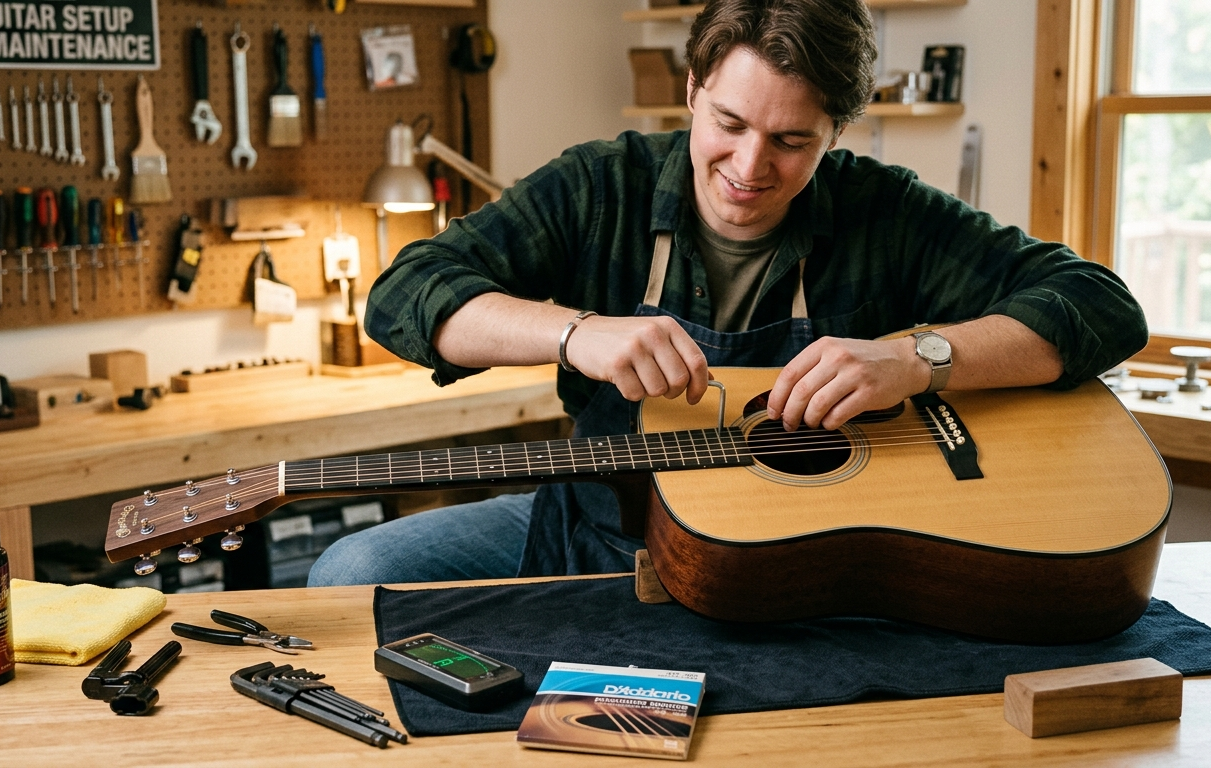
A badly maintained acoustic guitar is genuinely unpleasant to play, and the frustrating part is that most players don’t realize their guitar has a problem they just think playing guitar is supposed to be harder than it seems. Strings that are too high make every chord a small battle. A neck that’s bowed in the wrong direction makes every note above the 5th fret sound like a buzzy mess. These are fixable problems, and knowing how to address them yourself is one of the most useful skills a guitarist can develop.
This guide covers the essential maintenance tasks for acoustic guitar from string changes through truss rod adjustment in enough depth that you can handle most of them yourself, and enough context to know when you genuinely need a professional.
String Changes: How Often and What to Use
Most players change their strings far less often than they should. Acoustic strings corrode, accumulate oil from your fingers, and lose brightness and tone faster than you’d expect. If you play 30 minutes a day, changing strings every 4–6 weeks is reasonable. If you play less frequently, aim for every 2–3 months regardless strings oxidize even when unplayed.
String gauge affects playability significantly. Light gauge strings (0.012–0.053) are easier on fingers and have better tone at lower tensions. Medium gauge (0.013–0.056) project more and sustain longer but require more force. For intermediate players, lights are a sensible default unless you’re specifically looking for more volume or sustain. Elixir Phosphor Bronze lights with Nanoweb coating stay fresh noticeably longer than uncoated strings worth the extra cost if you don’t want to change strings frequently.
When stringing: pull the string through the bridge pin hole, ensure the ball end is seated against the bridge plate (not caught on the pin itself), wind the string onto the tuner post neatly with three or four winds for the wound strings and five or six for the plain strings, and stretch each string thoroughly before tuning to final pitch. New strings go out of tune constantly for the first few hours stretch them.
Action: What It Is and Why It Matters
Action is the distance between the strings and the fretboard. Low action makes the guitar easier to play; high action makes it harder. The sweet spot is low enough for comfortable playing without causing fret buzz on notes you’re playing cleanly.
Measure action at the 12th fret with a ruler. For acoustic guitar, the typical recommendation is 2.0–2.4mm on the high e string and 2.6–3.0mm on the low E string. If your measurements are significantly higher than this, the guitar will feel like hard work.
Action is controlled primarily by the nut (at the headstock end) and the saddle (at the bridge). High action at the first few frets is usually a nut issue the slots need to be filed deeper. High action at the higher frets is usually a saddle issue the saddle can be sanded down from the bottom to lower the string height. Both are DIY-able with patience and proper tools, but the nut is easier to ruin if you go too fast. If in doubt, have a tech do the nut.
The Truss Rod: Less Scary Than It Sounds
The truss rod is a metal rod running through the neck that counteracts the tension of the strings. Most necks need a small amount of relief a slight forward bow that creates a little extra clearance in the middle of the neck to prevent buzzing. A neck with too much relief plays like the strings are floating above the fretboard. A neck that’s back-bowed presses the strings against the frets in the middle positions, creating buzzing.
Check neck relief by pressing down a string at the 1st fret and the 14th fret simultaneously and looking at the gap at the 7th fret. A slight gap barely visible, maybe 0.1–0.2mm is ideal. If the string is touching the fret, the neck needs more relief (loosen the truss rod slightly, counterclockwise). If the gap is large, the neck has too much relief (tighten the truss rod slightly, clockwise).
Turn the truss rod a quarter turn at a time, wait 15–20 minutes for the neck to settle, and re-check. Do not force the rod. If it’s stiff or won’t turn with moderate hand pressure, stop and take the guitar to a tech forcing a truss rod can crack the neck.
Humidity: The Thing Most Players Ignore
Acoustic guitars are made of wood and wood responds to humidity. Too dry and the wood shrinks, causing sharp fret ends (you’ll feel little spikes along the neck edge), cracks, and lowered action as the top drops. Too humid and the wood swells, causing high action and potential glue joint failures.
The ideal humidity for acoustic guitar storage is 45–55% relative humidity. In dry climates or during winter heating season, this is hard to maintain without intervention. An in-case humidifier the D’Addario two-way humidification system is excellent and inexpensive will maintain this range and protect your guitar.
This is not optional information for guitars stored in variable-climate environments. Humidity damage to acoustic guitars is irreversible and expensive. A $25 humidifier and hygrometer protects a $1,000 guitar from hundreds of dollars in repair bills.
Cleaning and Fretboard Care
Wipe down strings and body after every session. Sweat and oil from your hands are the primary causes of string corrosion and finish degradation. A soft cloth does the job no special cleaner needed for the body unless it’s heavily soiled.
Unfinished rosewood or ebony fretboards need occasional conditioning with fretboard oil (Music Nomad or Dunlop 65 Lemon Oil are both reliable). This prevents the wood from drying out and cracking. Apply lightly, let it absorb for a few minutes, then wipe off the excess. Maple fretboards are typically finished and just need wiping down.
Conclusion
A well-maintained acoustic guitar is a pleasure. A poorly maintained one is a constant source of frustration that can make you think you’re a worse player than you are. Most of this maintenance is simple, low-cost, and learnable in an afternoon. The truss rod is the only adjustment that needs real caution everything else can be approached methodically with basic tools and patience.
FAQ
Can I adjust the truss rod myself without experience?
Quarter-turn adjustments on a truss rod that moves freely are generally safe for beginners. If the rod is difficult to turn, or if the neck has significant problems, take it to a professional. The cost of a setup ($40–$70) is far less than the cost of a cracked neck.
How do I know if my action is too high?
Chord playing feels harder than it looks in videos of other players. Chords sound slightly out of tune despite the open strings being in tune (high nut action causes this). Your fingertips hurt more than seems normal for intermediate playing.
Should I clean my guitar with furniture polish?
No. Many furniture polishes contain silicone, which can contaminate wood and damage finish over time. Use products specifically designed for guitar care, or simply use a dry or lightly damp soft cloth.