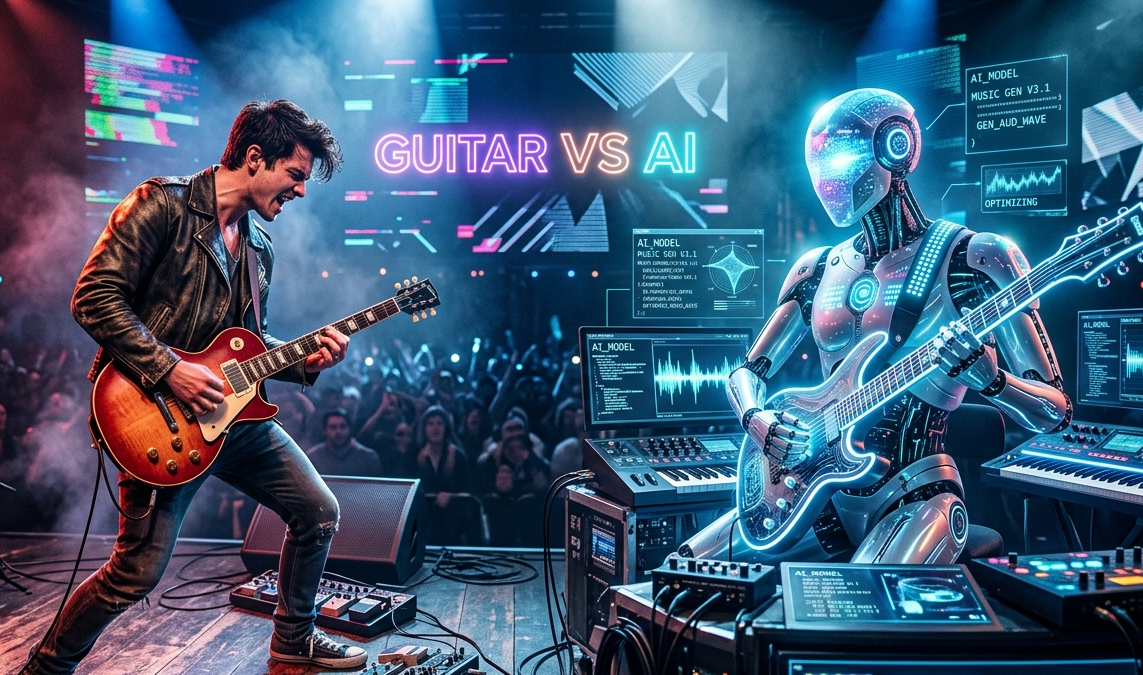
There’s a version of the AI conversation in music that’s all doom — AI replacing musicians, AI-generated songs flooding streaming platforms, and so on. And there’s a version that’s uncritical hype. Both miss the more interesting story, which is what happens when an actual practicing guitarist starts using these tools thoughtfully and figures out what genuinely helps versus what’s just a shiny distraction.
This is about the practical, ground-level reality of using AI tools in your guitar practice in 2026 — specifically for intermediate players who know their way around the fretboard but want to accelerate their growth.
What AI Transcription Tools Have Changed
For years, learning a guitar part by ear required patience, a good ear, and a lot of slowing-down software. AI-powered transcription tools have genuinely changed that game. Apps like Moises and tools built into platforms like Soundslice can now isolate guitar tracks from a full mix with impressive accuracy, slow them down without changing pitch, and even generate basic tab in real time.
The accuracy isn’t perfect — complex chords and dense polyphonic playing still confuse most models — but for learning riffs, identifying a chord voicing you couldn’t quite hear, or isolating a lead part from a busy mix, these tools save hours of frustrating replaying.
A practical workflow: import the song into Moises, isolate the guitar track, slow it to 70%, and work through it phrase by phrase. What used to take an afternoon now takes 45 minutes. The time saved can go into actual playing.
AI for Music Theory: Faster Than a Textbook, Better Than Most Tutors
This is where AI genuinely excels for guitar practice. If you’re working through a chord progression and you don’t understand why a bIII chord works in a minor key, you can ask a large language model and get a clear, accurate, context-specific explanation in seconds. You can ask follow-up questions. You can ask it to explain using examples from songs you know.
Compare that to Googling the same question, which lands you on forum threads from 2009 where the first three replies are arguments about whether music theory even matters. The AI route is not just faster — it’s often genuinely better for understanding because you can have a back-and-forth dialogue.
That said, always verify theory concepts against a reliable source or teacher if you’re planning to use them in performance or teaching contexts. AI makes mistakes in music theory, particularly around edge cases and advanced harmonic analysis.
Practice Feedback: What AI Can and Can’t Do
Several apps now offer real-time pitch and rhythm feedback — Yousician being the most well-known, though competitors like SimplyGuitar and Fender Play have improved their feedback systems significantly. These work on a basic level: they can tell you if you’re playing the right notes and whether your timing is consistent.
What they cannot do is tell you why your tone sounds wrong, whether your vibrato is musical, or whether the emotion is right. Those qualitative dimensions of playing are still entirely outside what AI evaluates well. A human teacher, even a modest one, hears things in your playing that no app currently catches.
The best use of AI feedback tools is for quantity practice — drilling a chord transition 50 times while getting confirmation that you’re landing on the right notes — not for quality refinement, which still needs a human ear.
AI Composition Assistants: Genuinely Useful for Breaking Blocks
If you write songs or improvise, AI composition tools can be surprisingly good creative partners. You’re not outsourcing creativity — you’re using AI to break out of your own habits. Give it a chord progression you’ve been working with and ask it to suggest an alternative progression that shares the same key. Ask it to outline a song structure based on a mood you describe. Ask it to suggest scales that would work over a specific chord sequence.
The ideas won’t always be good. A lot of them will be generic. But occasionally one suggestion will unlock something in your own thinking that you wouldn’t have reached alone. That’s worth the occasional bad idea. Think of it like having an infinitely patient co-writer who never gets tired but whose taste isn’t always perfect.
Honest Limitations
AI cannot develop your ear. Ear training — learning to identify intervals, chord qualities, and rhythmic patterns by sound alone — is still a deeply human, deeply physical skill that no app can shortcut. Spending time with an app is not the same as spending time listening to music carefully.
AI cannot replace the experience of playing with other people. Jamming with a drummer or a pianist forces you to lock in rhythmically, respond dynamically, and listen actively. These skills develop specifically through human interaction. No AI jam partner replicates it.
AI learning apps can create a dependency where you feel like you’re practicing but you’re really just going through app-validated motions. If you never play without an app giving you feedback, you won’t develop the self-listening and self-correction skills that make musicians independent.
A Practical AI Practice Stack for 2026
For learning songs: Moises or a similar stem-separation tool to isolate tracks, combined with a good slow-down app.
For theory questions: A large language model like Claude or ChatGPT, used conversationally. Ask specific, context-rich questions for better answers.
For rhythm practice: Traditional metronome apps are still the gold standard. AI rhythm tools add complexity without improving the core skill.
For composition: Use AI to generate suggestions and promptly play them on your guitar. The moment it goes from text to your hands, it becomes yours.
Conclusion
The best guitarists in ten years will be the ones who used AI intelligently — to remove friction in learning, to answer theory questions faster, and to break creative blocks — while maintaining the fundamentally human practices of listening deeply, playing with others, and developing their own musical instincts. AI is a powerful tool, not a teacher and not a replacement.
FAQ
Can AI teach me guitar better than a human teacher?
Not better overall, but more cheaply and more conveniently for certain aspects. AI is excellent for theory explanations, song learning, and rhythm feedback. Human teachers are better for technique refinement, motivation, and musical direction.
Are AI transcription tools accurate enough to trust?
For most popular music, yes — they’re accurate enough to use as a starting point. Always verify what you’re seeing against the original recording. Use AI-generated tabs as a scaffold, not scripture.
Will AI replace session guitarists?
For some applications — quick jingles, background music, video game scores — AI-generated guitar is already being used. For anything requiring authentic feel, genre-specific nuance, or human spontaneity, session musicians still have a clear edge.